
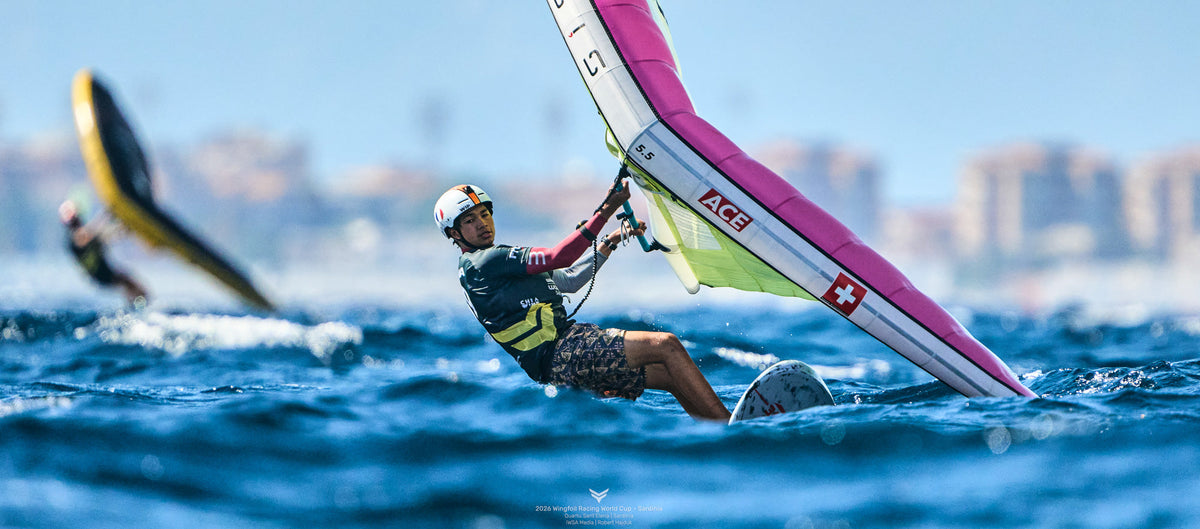
Five days of racing, consistent wind and challenging swell. ENSIS rider Dino Loicano shares what it takes to compete at the highest level of wingfoil racing, the equipment choices behind his performance and the lessons he is taking into his next competition.
From the beach, wingfoil racing looks like a battle of speed. On the water, it is also a constant exercise in decision-making: choosing the right equipment, reading the conditions, managing energy and finding the fastest route around the course.
At the 2026 WingFoil Racing World Cup Sardinia, held from 30 September to 4 October in Quartu Sant’Elena, riders faced five days of competition in the Gulf of Cagliari. For ENSIS rider Dino Loicano, the event was an opportunity to compete against some of the world's leading riders, test his skills in demanding conditions and identify what to work on next.

Photos courtesy of Robert Hajduk and IWSA Media.
What Is a WingFoil Racing World Cup?
Organised under the International Wing Sports Association (IWSA), the WingFoil Racing World Cup brings together international riders to compete in a structured racing format, with official race management and rules.
Unlike a freeride session, where riders can choose their own lines and focus on their individual goals, racing demands precision under pressure. Competitors must navigate a defined course, make tactical decisions around the marks and balance speed with control while racing against a fleet of other riders.
The World Cup format includes qualifying races, where consistency is essential to progress, followed by a Medal Series that determines the event's leading finishers. In Sardinia, the top nine riders in each fleet advanced to the Medal Series, with the top two earning a direct route to the Grand Final.
With positions often separated by small margins, a crash or a tactical mistake can have an immediate impact on the result. Every start, turn and decision matters.

Five Days of Wind and Swell in Sardinia
Sardinia delivered consistent conditions throughout the event, with wind every day and plenty of swell.
For Dino, the biggest challenge was maintaining speed while sailing upwind through the waves.
My biggest challenge was to stay fast with the waves on the upwind”.
Sailing upwind in swell requires more than simply pointing the board towards the next mark. Riders need to manage their speed and balance through changing water surfaces while finding an efficient line towards the mark. Losing momentum can cost valuable distance and positions.
Dino also highlighted how important equipment choice becomes in these conditions. Wing size influences how a rider manages power and control, while the swell adds another variable to consider when choosing a setup.
“Choosing the perfect size of wing is very important during these types of swell conditions. From my point of view, I prefer to use a mid-size sail”, he explains.

Choosing the Right Wing: ENSIS DOUBLE ACE 5.5 m²
Throughout the competition, Dino mainly used the ENSIS DOUBLE ACE 5.5 m², a wing he chose for the demands of long-distance upwind racing and the shorter-distance races that followed.
The DOUBLE ACE is designed for advanced riders focused on race performance, with a full double-skin canopy and an aerodynamic design developed for speed and efficiency.
For Dino, the 5.5 m² proved suitable for the stable wind conditions in Sardinia, which ranged from 18 to 28 knots. Because the wind remained consistent, he kept the same wing throughout the event rather than changing sizes between races.
This illustrates an important part of racing preparation: equipment decisions are not made in isolation. Riders must consider wind strength, the state of the water, the course and the demands of each race when deciding on their setup.
Dino also used the ENSIS e-pump to save energy before racing. In a competition where physical effort accumulates across multiple sessions and days, managing energy is part of the preparation.

Training vs. Racing: Every Second Counts
One of the biggest differences Dino noticed between training and competition was the consequence of a crash.
During training days, if you crash, nothing happens. But if you crash during a race, you can lose lots of positions in seconds”.
In training, a mistake is an opportunity to experiment, repeat a manoeuvre and learn. During a race, the same mistake can allow several competitors to pass before a rider gets back on the foil and regains speed.
That pressure changes the way riders approach every manoeuvre. Technical ability remains essential, but so do consistency, awareness of other competitors and the ability to make decisions quickly.
For Dino, one of the main lessons from Sardinia was learning to sail faster and more effectively through swell — a skill he will continue to develop in upcoming competitions.

From Sardinia to Granville: preparing for the Next Challenge
Dino's next competition is the French Kiteboard & Wingfoil Championships in Granville, France, scheduled for 19–25 October 2026.
The event brings together kiteboard and wingfoil disciplines, including slalom-race and freestyle. Its format is designed around the local conditions, with the competition site selected according to the weather and wind each day.
For Dino, the next challenge also means adapting his equipment. Due to the restrictions applying to his upcoming racing category, he is preparing to compete with a single-skin wing, moving from the DOUBLE ACE used in Sardinia to the ENSIS TOPSPIN.
This shift makes the next event an opportunity to work on a different aspect of his racing. Dino wants to improve his skills with single-skin wings and continue developing the speed and control needed to compete effectively.

More Than a Result
For Dino, competing at a World Cup is about measuring himself against the best riders and finding out how far he can push his own abilities.
Racing a World Cup means a lot to me — to race with top riders and to get the best out of me".
Every event brings a different combination of conditions, equipment decisions and tactical challenges. Sardinia gave Dino valuable experience racing through swell, managing his energy and understanding the consequences of mistakes under pressure.
Now, with Granville approaching, the focus shifts to adapting his equipment and refining his single-skin racing skills.
The learning continues — one race, one decision and one session at a time.
Follow ENSIS rider Dino Loicano as he takes on his next racing challenge in France.
Share:
MANIAC Carbon Mast or MANIAC ACE Mast? Which Mast Is Right for You?