
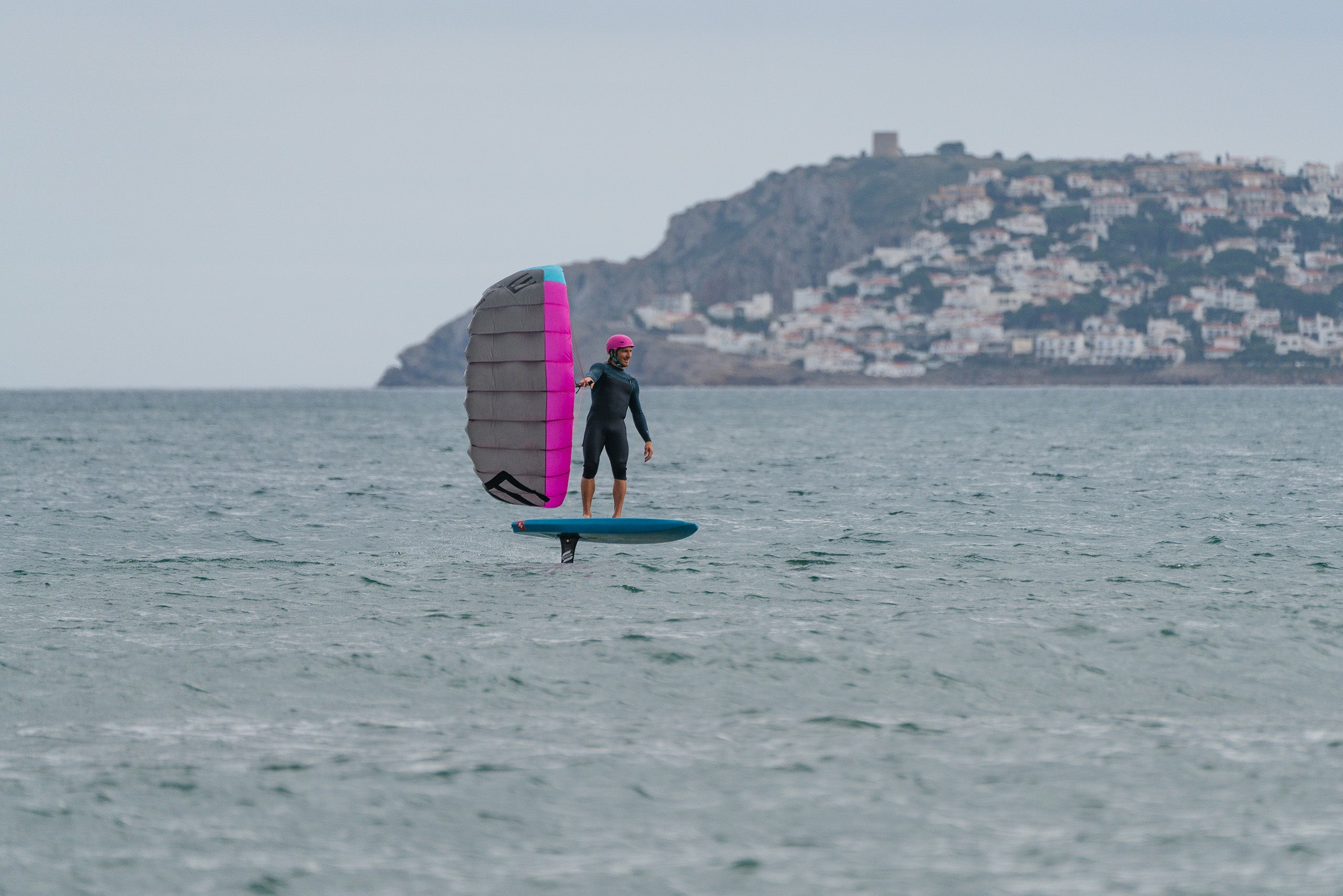
Parawinging has taken the foiling scene by storm. At ENSIS, we’re excited to join the movement with the release of the ENSIS ROGER. (If you haven’t seen it yet, go check it out!) Understandably, people have a lot of questions about parawinging: Why would you want to parawing? What’s the difference between an inflatable wing and a parawing? How do you get started? We’ll address some of the most commonly asked questions. To give you the inside scoop, we also asked Balz Müller, our resident foil fanatic, to share his thoughts on parawinging.

Why parawing?
Reactions to parawinging tend to fall into two camps. Some riders are thrilled, seeing it as the ultimate tool for downwinders they’ve always wanted and the others “iT iS jUst kiTeSurFinG!” or “WhY nOt JusT uSe A wInG?”
We get it—but here’s why parawinging is different.
Foils are incredibly efficient. This efficiency is what fueled the popularity of wingfoiling in the first place. With the right foil, you can generate lift even on the smallest wind swell, which has led to a committed community of downwind riders who chase never ending waves, this is where the parawing shines! Use the parawing to easily get onto the foil and once you’re up and riding a wave or swell, you can fully pack away the parawing. This leaves you free to ride purely on the energy of the water. It’s a seamless blend of wind and wave power, opening up an entirely new dimension of foiling. Parawinging is for downwind enthusiasts chasing that never ending wave, and riders wanting to explore something new!

Chatting with Balz:
When do you use a parawing?
Parawing opens new opportunities for surf foiling! Especially downwind foiling when it’s said onshore wind (I‘ll do now zigzag lines out/in ) or in challenging crosswell - I just pick the fun bumps and ride them all in -knowing I‘ll be up on foil super easy again. Then the parawing is also an amazing support at spots where you have to reach far offshore to get into the great conditions. But then I also love to use the parawing at wavespots with sideshore winds as you can drag yourself (like behind a ski elevator) out to the peak then pack the parawing and surf hands free back in.

What you need to get started
If you’re already an experienced foiler, you’ll pick up parawinging pretty quickly. Beginners, on the other hand, will probably struggle, so we recommend spending plenty of time on the foil before trying to parawing.
The size of a parawing is pretty similar to an inflatable wing, but it’s designed to work best with longer boards like the WALTZ and downwind foils. It’ll work with standard wingboards, but it’s going to be much harder. As for foils, pretty much anything will do, but if you’re after the best downwind experience, you’ll want a downwind foil - generally a high-aspect, wider-wingspan setup suited to your conditions.
One thing to keep in mind: the parawing doesn’t float like an inflatable wing, so make sure you’re using a board leash.
Oh, and if you’re just getting started, Michi and Laura have made an awesome parawing tutorial - definitely check it out!
Chatting with Balz:
How difficult is foiling with a parawing compared to wingfoiling?
Getting pulled up on the foil is easy and super accessible for most people who already know how to foil. But I guess learning to handle, pack, steer the parawing will be a little more challenging than with the inflatable wing.
What board size or type is best?
I love my 95l 6‘3“ waltz, the longer and narrow shape makes it super easy to get up foiling. I can imagine with the sport and skills improving I am also enjoying smaller mid-length boards.
Do you mount a leash?
Having the parawing on a leash is not mandatory as it wont fly away or sink immediately. But I highly recommend using a board leash.

The ENSIS ROGER
The ENSIS ROGER was designed with parawinging in mind, offering stability, control, and the freedom to explore. Its lightweight, single-skin design makes it easy to pack away while riding, and just as easy to redeploy when needed. The intuitive colour-coded setup and reliable power control mean less time fussing with gear and more time enjoying the ride. Whether you’re gliding effortlessly on swells or navigating challenging conditions, the ROGER delivers.
For more details, Balz and Michi share everything you need to know about the ROGER in their tech talk. Don’t miss it!

Share:
Parawing! Launch of the ENSIS ROGER.
Why you should try the SCORE Limited Edition